
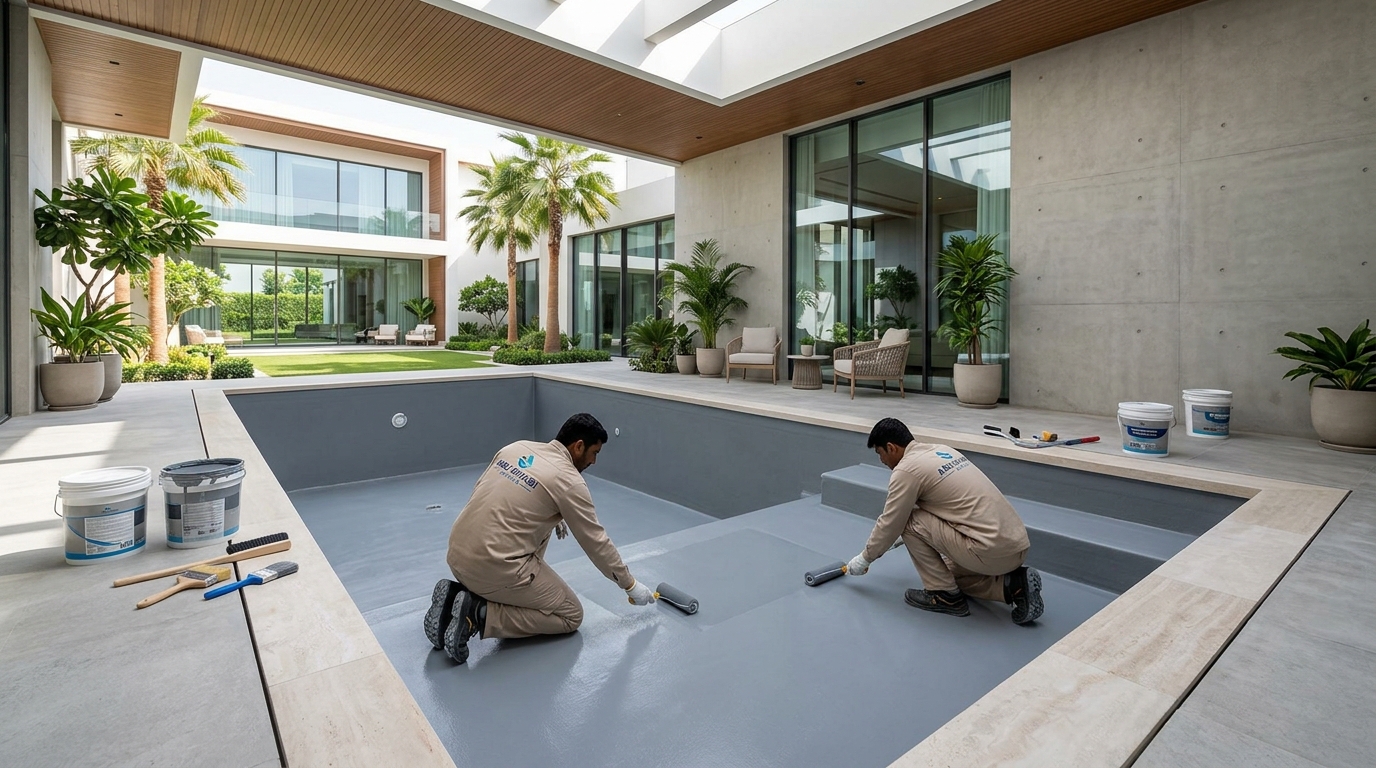

Swimming Pool Waterproofing in the Abu Dhabi: The Complete 2026 Guide
Everything Abu Dhabi and UAE homeowners need to know about pool waterproofing material, methods, and cost — explained by Atlanta Pools.
A leaking pool rarely announces itself with a dramatic flood. Instead, it shows up as a damp patch on the terrace, a rising water bill, or tiles that quietly lift after a scorching summer. That is exactly why swimming pool waterproofing is not an optional finishing touch in the UAE — it is the layer of protection that decides whether your pool lasts five years or twenty-five. Because Abu Dhabi’s soil salinity, high humidity, and intense heat all work against untreated concrete, the right waterproofing system becomes the difference between a pool you enjoy and a pool you constantly repair.
In this guide, Atlanta Pools breaks down every swimming pool waterproofing material available in the UAE market, walks through cementitious waterproofing swimming pool systems in detail, and answers the question every villa owner eventually asks: how to waterproof a pool correctly, the first time.
Table of Contents
- Why Waterproofing in Swimming Pool Construction Matters in the UAE
- Swimming Pool Waterproofing Material: Comparing Your Options
- Cementitious Waterproofing Swimming Pool Systems Explained
- Liquid Membranes, Bituminous Coatings & Sheet Membranes
- How to Waterproof a Pool: Step-by-Step Process
- Warning Signs Your Pool Needs Waterproofing
- Cost Factors for Pool Waterproofing in Abu Dhabi
- Why Atlanta Pools for Your Waterproofing Project
- Frequently Asked Questions
Why Waterproofing in Swimming Pool Construction Matters in the UAE
Concrete is naturally porous. Left untreated, it absorbs pool water through thousands of microscopic capillaries. Over time, this moisture reaches the reinforcement bars inside the shell and triggers corrosion, which then expands the steel and cracks the surrounding concrete from within. This process, known technically as waterproofing failure, accelerates dramatically in coastal Gulf conditions where groundwater carries high salt content.
Abu Dhabi properties face three compounding challenges. First, the water table sits close to the surface in many areas, pushing external moisture (a phenomenon called negative-side pressure) against the pool shell. Second, summer surface temperatures regularly exceed 45°C, which causes rapid expansion and contraction cycles in concrete and tile adhesive.
Third, chlorinated and salt-chlorinated pool water is chemically aggressive, and it slowly degrades any surface that lacks a proper protective barrier. Consequently, a pool without a dedicated waterproofing system in swimming pool construction rarely survives its first decade without major structural repair.
Arabic-speaking clients often search for this service as عزل حمامات السباحة or عزل المسابح, and the underlying concern is identical across languages: keeping water where it belongs, inside the pool shell, rather than seeping through it. At Atlanta Pools, every swimming pool construction project begins with this layer, because retrofitting it later always costs more than building it right the first time.
Swimming Pool Waterproofing Material: Comparing Your Options
Choosing the right swimming pool waterproofing material depends on your pool’s structure, budget, and exposure to groundwater. Below is a comparison Atlanta Pools uses when advising clients across Abu Dhabi villas and commercial developments.
| Material | Best For | Key Advantages |
|---|---|---|
| Cementitious Coating | New concrete pools, positive-side application | Bonds directly to concrete, tile-ready, cost-effective |
| Liquid Polyurethane Membrane | Pools with movement joints or curved shells | Fully flexible, seamless, high elongation under thermal stress |
| Bituminous Membrane | Below-ground negative-side protection | Strong resistance to groundwater and salt intrusion |
| Crystalline Waterproofing | Pools needing self-healing protection | Penetrates concrete pores, seals hairline cracks over time |
| PVC / Sheet Liner Membrane | Renovation projects and irregular geometries | Fast installation, visible finish, easy leak detection |
Each swimming pool waterproofing material behaves differently under UAE conditions, so selecting one without a site assessment often leads to premature failure. Atlanta Pools tests soil moisture and shell condition before recommending a system, rather than applying a one-size-fits-all coating.
Cementitious Waterproofing Swimming Pool Systems Explained
Cementitious waterproofing swimming pool systems remain the most widely used solution across Abu Dhabi villas, and there is a practical reason for that popularity. The coating is cement-based, so it bonds chemically with the concrete substrate rather than simply sitting on top of it like a paint film. As a result, it creates a rigid, mineral-based barrier that resists both positive water pressure from inside the pool and the chemical load of chlorinated water.
The application typically involves two to three coats, brushed or trowelled onto a clean, saturated concrete surface. Between coats, technicians allow proper curing time, since rushing this stage is the single most common cause of premature failure. Once cured, the surface becomes ready to receive tile adhesive, plaster, or a pebble finish directly — which is why builders favour it for new pool shells.
However, cementitious systems have one limitation worth noting: they offer minimal flexibility. If your pool shell sits on reactive soil or spans a large surface without expansion joints, hairline cracking can eventually telegraph through the coating. For that reason, Atlanta Pools often pairs cementitious waterproofing with a flexible additive or reinforcing mesh at corners, steps, and joints — the exact points where movement concentrates.
Quick Insight: Where Cracks Usually Start
Pool corners, step edges, and skimmer cut-outs experience the highest structural stress in a shell. Reinforcing these points before applying cementitious waterproofing swimming pool coatings prevents roughly 70% of the leak calls Atlanta Pools receives across Abu Dhabi.
Liquid Membranes, Bituminous Coatings & Sheet Membranes
Beyond cementitious systems, several other approaches to waterproofing in swimming pool projects suit specific site conditions.
Liquid polyurethane membranes cure into a seamless, rubber-like layer that stretches with the concrete rather than cracking against it. Because of this elasticity, contractors specify these membranes on infinity edges, raised spas, and pools with unusual curves, where a rigid coating would eventually fail.
Bituminous membranes work from the negative side, meaning they are applied to the exterior of the shell before backfilling. This method suits villas with a high water table, since it blocks groundwater before it ever reaches the concrete. Atlanta Pools recommends this approach whenever excavation reveals damp or saline soil during construction.
Crystalline admixtures take a different route entirely. Instead of forming a surface layer, active chemicals mixed into the concrete react with moisture to grow crystals inside the pores, physically blocking water pathways. Interestingly, this system keeps working for the life of the structure — even a future hairline crack can trigger the crystals to reactivate and reseal, which makes it popular for commercial pools that cannot tolerate downtime.
Finally, PVC sheet liners offer a practical fix for renovation projects where the existing shell has multiple leak points that are difficult to trace individually. Rather than chasing each crack, the liner creates one continuous waterproof skin across the entire pool surface, and it also refreshes the pool’s appearance in a single project.
How to Waterproof a Pool: Step-by-Step Process
Understanding how to waterproof a pool correctly helps homeowners ask the right questions when hiring a contractor, even if the actual application should always be left to trained technicians.
Step 1: Surface Preparation
Technicians grind away laitance, oil residue, and loose debris from the concrete shell. A clean, slightly porous surface allows the waterproofing material to bond properly, so skipping this step undermines everything that follows.
Step 2: Crack and Joint Treatment
Structural cracks, cold joints, and pipe penetrations receive targeted repair using polymer-modified mortar or injection resin before the main coating goes on, since a coating applied over an active crack simply masks the problem temporarily.
Step 3: Reinforcement at Stress Points
Fiberglass mesh or fillet strips get embedded at corners, floor-to-wall junctions, and around fittings. This reinforcement absorbs minor movement without transferring stress into the waterproofing layer itself.
Step 4: Applying the Waterproofing System
The selected swimming pool waterproofing material — cementitious, membrane, or crystalline — goes on in multiple coats, with curing time observed between each layer. Technicians check coverage thickness at this stage using wet-film gauges, rather than estimating visually.
Step 5: Flood Testing
Before tiling begins, the pool gets filled with water and monitored for 48 to 72 hours. This flood test confirms the waterproofing holds under real hydrostatic pressure, and it catches any weak spot while repairs are still simple.
Step 6: Tiling or Finishing
Once the system passes testing, the pool receives its final finish — tile, pebble, or plaster. Atlanta Pools coordinates this stage closely with waterproofing so the finish never compromises the barrier underneath.
Warning Signs Your Pool Needs Waterproofing
Existing pools rarely need a full rebuild; often, a targeted waterproofing repair solves the issue. Watch for these indicators:
- Water level drops noticeably faster than evaporation alone would explain.
- Damp patches or salt staining appear on the deck surrounding the pool.
- Tiles loosen, pop, or develop hollow-sounding sections when tapped.
- Cracks widen visibly across a full season rather than staying static.
- The pump runs constantly to maintain a stable water level.
If any of these apply, a professional inspection through Atlanta Pools’ swimming pool maintenance team pinpoints the source before the damage spreads further into the structure.
Cost Factors for Pool Waterproofing in Abu Dhabi
Pricing for swimming pool waterproofing in the UAE varies with several practical factors rather than a flat rate. Pool size and surface area obviously scale material quantity, but shell condition matters just as much — a pool with existing cracks or old tile removal adds preparation labor. The chosen waterproofing material also shifts cost: crystalline and liquid membrane systems generally command a premium over standard cementitious coatings because of their extended performance and flexibility.
Access also plays a role. Villas with tight rear-garden access sometimes require manual material transport, which adds time to the project. Because every site differs, Atlanta Pools provides a free, no-obligation site visit before quoting, so homeowners receive an accurate figure rather than a generic estimate.
Get a Free Waterproofing Assessment
Atlanta Pools inspects your shell, identifies the exact failure points, and recommends the right waterproofing material — no guesswork, no upselling.
Why Atlanta Pools for Your Waterproofing Project
Atlanta Pools has waterproofed and built pools across Abu Dhabi villas, compounds, and commercial sites, and that hands-on experience shapes every recommendation we make. Rather than defaulting to whichever material carries the highest margin, our technicians assess soil condition, shell age, and budget before proposing a system. Every project also includes a flood test before tiling begins, so clients see proof of performance rather than a verbal assurance.
Because waterproofing rarely stands alone, Atlanta Pools connects it naturally with related work. Clients building a new pool often pair this stage with our swimming pool construction service, while owners renovating an older shell frequently combine waterproofing repair with fresh sandstone wall tiles or updated flooring around the pool deck. For villas exploring a fully enclosed option, our guide on the indoor pool in Abu Dhabi covers waterproofing considerations unique to enclosed structures. And once your pool is protected, ongoing AMC services keep water chemistry balanced so the waterproofing layer isn’t degraded prematurely by aggressive chemical levels.
Explore Related Atlanta Pools Services
Frequently Asked Questions
1. What is the best swimming pool waterproofing material for UAE villas?
Cementitious waterproofing suits most new concrete pools, while liquid membranes work better for shells with curves or joints. Atlanta Pools confirms the right fit after a site inspection.
2. How long does cementitious waterproofing swimming pool application take?
A standard residential pool typically takes three to five days, including curing time between coats and a flood test before tiling.
3. Can an existing pool be waterproofed without a full rebuild?
Yes. Most leaks stem from localized joint or crack failure, and targeted repair often restores the shell without demolition.
4. Does waterproofing in swimming pool construction affect tile installation?
It actually improves it. A properly cured waterproofing layer gives tile adhesive a stable, uniform surface to bond with.
5. How often should pool waterproofing be inspected?
Atlanta Pools recommends a visual check every year, alongside routine maintenance visits, to catch early cracking before it spreads.
Protect Your Investment With Atlanta Pools
A pool is one of the largest outdoor investments a UAE homeowner makes, and its lifespan depends almost entirely on what happens beneath the tiles. Whether you’re planning a new build or repairing an aging shell, getting the swimming pool waterproofing material and application process right the first time saves years of frustration and cost down the line.
Atlanta Pools has guided villa owners and commercial clients across Abu Dhabi through exactly this decision, backing every project with tested materials, flood verification, and a team that stands behind its work.
Ready to Waterproof Your Pool the Right Way?
Talk to Atlanta Pools today for a free site visit and honest recommendation — no pressure, no hidden costs.