

Table of Contents
- Why Abu Dhabi’s Climate Changes Every Outdoor Wall Tiles Decision
- Tile Ratings You Must Confirm Before Buying
- Outdoor Wall Tiles Design for Abu Dhabi Villa Facades
- Outdoor Wall Tiles Around Pools in Abu Dhabi
- Outer Wall Tiles for Boundary Walls and Garden Features
- Material Comparison: Porcelain, Sandstone, and Rock-Effect Tiles
- Interior Wall Tiles: Kitchen, Bathroom, and Living Room
- How to Brief Your Abu Dhabi Tiling Contractor
- Choosing a Tiling Partner in Abu Dhabi
- Related Reading
- Explore More Atlanta Pools Services
- Frequently Asked Questions
Outdoor Wall Tiles Abu Dhabi: The Complete Buyer’s Guide for Villas, Pools, and Facades
Abu Dhabi’s heat, humidity, and salt air punish ordinary tiles within a single summer. This guide explains exactly which outdoor wall tiles survive the climate, how to specify them correctly, and where Atlanta Pools fits into every stage of the project.
Drive through any established Abu Dhabi neighbourhood and the pattern becomes obvious quickly. Some villas still look sharp after a decade, while others show cracked cladding and faded render within a few short years. Consequently, the difference rarely comes down to budget alone; it comes down to whether the outdoor wall tiles were specified for this exact climate.
At Atlanta Pools, our teams tile poolside walls, villa facades, boundary walls, and interior feature walls across Abu Dhabi every week. Because of that daily exposure to local conditions, we know precisely which materials hold up and which ones fail early. This guide shares that experience in full.
Why Abu Dhabi’s Climate Changes Every Outdoor Wall Tiles Decision
Abu Dhabi’s summer sun pushes exterior wall surface temperatures well above 70°C, not the ambient air temperature, but the actual surface itself under direct exposure. Meanwhile, winter nights can drop the same surface to 10°C or lower. As a result, outdoor wall tiles here face a daily thermal swing that most standard products were never designed to survive.
Furthermore, Abu Dhabi’s coastal position adds a second challenge: salt-laden humidity. Tiles with even slight surface porosity absorb this moisture over time, and once it reaches the tile body, thermal expansion forces it back out through cracking or spalling. Therefore, porosity is not a minor spec detail here; it is often the single factor that decides whether a wall lasts five years or twenty.
The UAE’s Ministry of Climate Change and Environment classifies the country as an extreme hot desert climate with intense UV exposure. Consequently, any outdoor wall tiles specification for an Abu Dhabi property needs to account for UV stability, thermal shock resistance, and salt resistance together, not as separate considerations. For background on the region’s climate classification, see the UAE Ministry of Climate Change and Environment.
Tile Ratings You Must Confirm Before Buying
Most buying guides skip the technical ratings entirely, yet these numbers are exactly what separates a wall that lasts from one that fails. Before approving any outdoor wall tiles order in Abu Dhabi, confirm the figures below.
| Rating | Minimum Standard for Abu Dhabi | Why It Matters |
|---|---|---|
| Water absorption (ISO 10545-3) | Below 0.5% | Prevents moisture entering the tile body and cracking under heat |
| Slip resistance (R-rating) | R9 general areas, R11–R12 near pools | Reduces slip risk on wet horizontal surfaces |
| PEI hardness | PEI 3 for walls, PEI 4–5 for horizontal areas | Resists scratching from dust and sand exposure |
| Rectified edges | Recommended for large facades | Allows narrow 1.5mm joints for a cleaner finish |
Notably, a supplier who cannot provide a water absorption figure on request should be treated as a red flag immediately. In addition, rectified tiles generally suit large villa facades better than non-rectified options, since wide joints on a big wall trap dust quickly in Abu Dhabi’s dry, sandy air.
Outdoor Wall Tiles Design for Abu Dhabi Villa Facades
Villa architecture across Abu Dhabi communities like Saadiyat Island, Al Raha Gardens, and Khalifa City has shifted noticeably over the past decade. Plain rendered facades are giving way to layered material palettes that look considered rather than default.
A strong outdoor wall tiles design for Abu Dhabi villas typically layers two or three materials together. A base of large-format matte porcelain across the main elevation, an accent band of sandstone wall tiles near entrances, and a rock tile wall panel behind the main gate create a facade that reads as intentional rather than uniform. Consequently, this approach has become the most requested look on new-build and renovation projects alike.
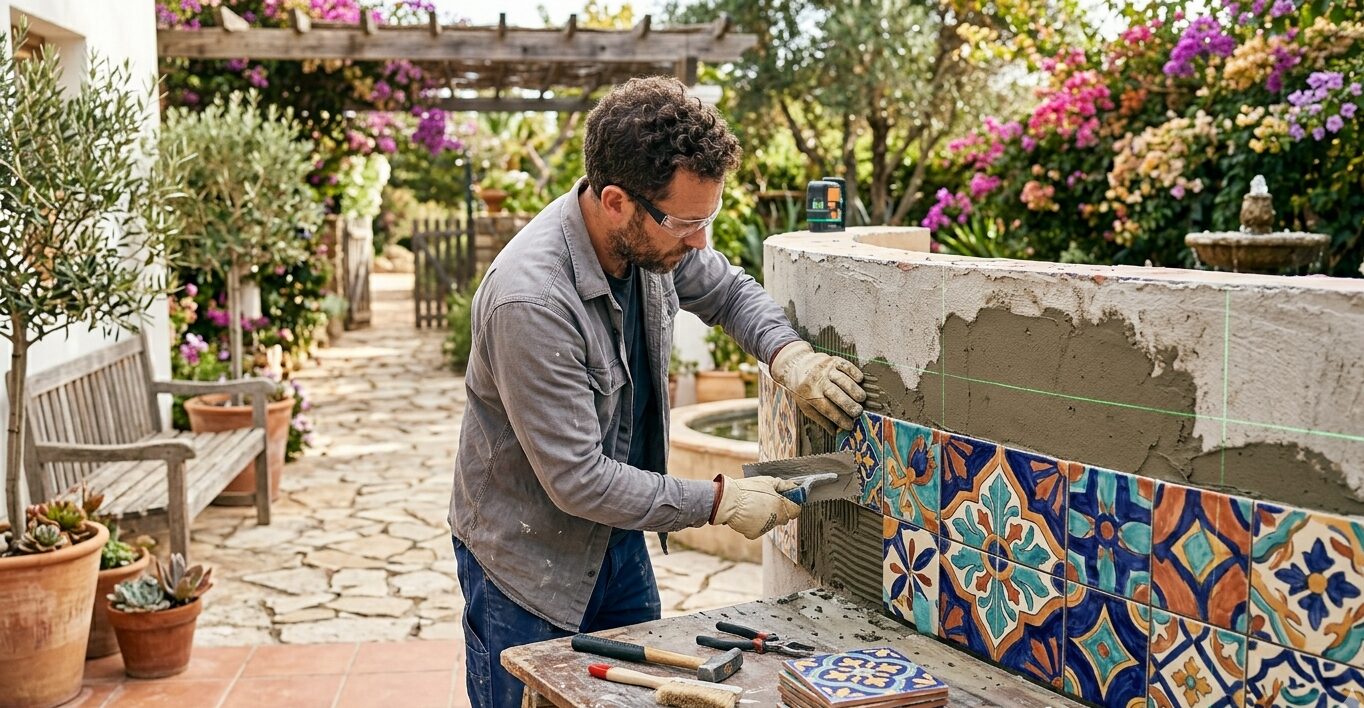
Installation matters just as much as material choice. Facade tiling should use a ventilated cavity or, at minimum, a polymer-modified adhesive rated for high exterior temperatures, since standard cement adhesive fails under Abu Dhabi’s thermal swings. Our team applies this specification through every project handled under our facade and cladding work, keeping the finish stable well beyond the first summer.
Outdoor Wall Tiles Around Pools in Abu Dhabi
Poolside walls represent the most demanding tiling scenario on any Abu Dhabi property. Constant UV exposure, chlorinated splash, standing moisture, and reflected heat off the water surface all act on the same wall simultaneously. Therefore, generic outdoor tiles are rarely suitable here.
For raised pool walls and bond beams, full-body vitrified porcelain with water absorption under 0.1% is the standard specification. Meanwhile, grout choice deserves equal attention: epoxy-based grout resists algae growth in a pool environment, whereas cement grout typically needs constant chemical cleaning within months of installation.
Glass mosaic tiles remain the preferred finish for waterline bands, since they tolerate constant submersion while catching light attractively. For the surrounding exterior walls, neutral stone-effect porcelain usually complements the pool rather than competing with it visually. If your outdoor wall tiles project sits alongside new pool work, our pool construction and repair service in Abu Dhabi and swimming pool cleaning service keep both the structure and the ongoing maintenance aligned with the same specification.
Outer Wall Tiles for Boundary Walls and Garden Features
Boundary walls are frequently treated as an afterthought, which explains why so many Abu Dhabi properties end up with entrance walls that feel disconnected from the main villa. However, a small amount of planning fixes this easily.
Outer wall tiles design for a boundary wall should echo one material already used on the main facade. If sandstone waraps the entrance, matching sandstone pillars along the boundary wall create visual continuity. Similarly, if the facade uses concrete-effect porcelain, carrying that same tile family onto the boundary wall ties the whole property together.
Rock tile wall panels, whether split-face slate, stacked limestone, or rough travertine, work particularly well here because they break up long flat surfaces with natural texture. Unlike rendered walls, which crack and peel under Abu Dhabi heat, these panels tend to look better with age rather than worse. When boundary wall tiling runs alongside planting, our landscaping and gardening service in Abu Dhabi and garden maintenance services help coordinate stone tones with the surrounding greenery, so the finished space reads as one cohesive design rather than separate projects.
Material Comparison: Porcelain, Sandstone, and Rock-Effect Tiles
Choosing between materials often comes down to how much maintenance an owner is willing to commit to, balanced against the natural character each material brings. The table below compares the main options used across Abu Dhabi outdoor wall tiles projects.
| Material | Best For | Maintenance Level |
|---|---|---|
| Large-format porcelain | Facades and pool surrounds | Very low, no sealing required |
| Sandstone wall tiles | Entrances and traditional facades | Moderate, reseal every 18–24 months |
| Rock-effect porcelain | Accent panels and gate pillars | Very low, consistent sizing |
| Glass mosaic | Pool waterline bands | Low, resists chlorine and submersion |
In particular, sandstone brings a warmth that manufactured tiles rarely replicate, but its porosity, typically 3% to 8% water absorption, means it needs a penetrating sealer before installation and regular resealing afterward. When properly maintained, it ages gracefully; when neglected, it stains and erodes noticeably faster in Abu Dhabi’s climate than in milder regions.
Interior Wall Tiles: Kitchen, Bathroom, and Living Room
While outdoor wall tiles handle the harshest conditions, interior spaces still need careful specification in an Abu Dhabi home. The cards below summarise what works best in each room.
Kitchen Wall Tiles
Large-format glazed porcelain in slab sizes reduces grout lines, which limits grease and steam buildup during daily cooking.
Bathroom Wall Tiles
Full-height travertine-effect porcelain, paired with a proper tanking membrane, prevents AC-condensation moisture issues behind the wall.
Living Room Feature Walls
Book-matched slab porcelain, installed floor to ceiling with concealed LED strips, creates a genuinely architectural focal point.
How to Brief Your Abu Dhabi Tiling Contractor
Most tiling failures in Abu Dhabi trace back to a weak brief rather than poor tiles. Confirm the following points with any contractor before work starts.
Waterproofing Confirmation
Every wet area needs a waterproofing membrane before tiling begins, and exterior walls need a proper primer coat first.
Correct Adhesive Rating
Exterior and pool zones require a C2TE or C2TES1 flexible adhesive, since standard cement fails under thermal movement.
Expansion Joint Plan
Any exterior surface larger than 4 square metres needs movement joints every 3 to 4 metres, filled with sealant, not grout.
Ultimately, a written specification covering these three points prevents the vast majority of early tiling failures seen across Abu Dhabi properties.
Choosing a Tiling Partner in Abu Dhabi
Selecting outdoor wall tiles for an Abu Dhabi property is a decision that compounds over time. A correct specification looks better every year, while a weak one costs money and frustration within the first summer alone.
At Atlanta Pools, every tiling project starts with a surface assessment and a written specification before any material is ordered. Whether the work involves poolside cladding alongside new pool construction, exterior facade tiling paired with landscaping, or interior feature walls on their own, our team manages the specification, installation, and finishing to a standard built for local conditions.
You can browse our completed projects to see real Abu Dhabi installations, or reach out through our Contact Us page to discuss a project directly.
Related Reading
- Pool Construction and Repair Service in Abu Dhabi
- Landscaping and Gardening Service in Abu Dhabi
- Swimming Pool Cleaning Service
- Flooring and tiling solutions for Abu Dhabi homes and pools
- Spa with sauna interior design ideas for Abu Dhabi homes
- . Benefits of sandstone wall tiles for Abu Dhabi homes and pools
Explore More Atlanta Pools Services
Explore our related work, including garden maintenance services for keeping outdoor spaces alongside new tiling looking sharp, and our completed projects to see finished outdoor wall tiles installations across Abu Dhabi villas and pools.
Frequently Asked Questions
What water absorption rate should outdoor wall tiles have in Abu Dhabi?
Below 0.5% is standard, placing the tile in the porcelain stoneware category suited to Abu Dhabi’s thermal swings.
Do poolside outdoor wall tiles need special grout?
Yes, epoxy grout is required near pools, since cement grout breaks down quickly under chlorine exposure.
Can sandstone wall tiles handle Abu Dhabi summers?
Yes, provided the stone is sealed before installation and resealed every 18 to 24 months for lasting protection.
Why do rectified tiles suit large facades better?
Rectified edges allow joints as narrow as 1.5mm, giving large walls a cleaner finish that collects less dust over time.
Does Atlanta Pools handle both tiling and pool construction?
Yes, at Atlanta Pools our team coordinates tiling specification alongside pool construction, landscaping, and garden maintenance projects.
Ready to specify outdoor wall tiles built for Abu Dhabi’s climate?
Share this post: