

Table of Contents
- What Is an Automatic Drip Irrigation System?
- Why Abu Dhabi Gardens Need an Automatic Drip Irrigation System
- Core Components of an Automatic Drip Irrigation System
- Automatic Drip Irrigation System vs Sprinkler and Manual Watering
- Pipe Materials and Emitter Options for an Automatic Drip Irrigation System
- Designing an Automatic Drip Irrigation System for Home Gardens
- Automatic Drip Irrigation System Installation: Step-by-Step Process
- Automatic Drip Irrigation System Cost Guide for Abu Dhabi Villas
- Automatic Drip Irrigation System Maintenance and Seasonal Scheduling
- Seven Mistakes That Can Ruin an Automatic Drip Irrigation System
- Why Homeowners Choose Atlanta Pools for Automatic Drip Irrigation Systems
- Frequently Asked Questions
Automatic Drip Irrigation System in Abu Dhabi: The Complete Homeowner’s Guide
Abu Dhabi summers punish every garden. Temperatures climb past 45°C, humidity swings wildly, and sandy soil drains faster than most plants can drink. Meanwhile, water tariffs continue to influence household landscaping costs. Because of this, a well-planned automatic drip irrigation system has become an important solution for gardens across Khalifa City, Al Reem Island, Yas Island and Mohammed Bin Zayed City. In addition, proper irrigation helps homeowners deliver water closer to plant roots instead of wasting it across unwanted areas. This guide explains how the technology works, what it costs, and how to specify it correctly for UAE conditions.
Traditional hose watering can waste a significant volume of water. Furthermore, it can soak leaves during peak sun, which may scorch foliage and encourage fungal problems. A modern automatic water irrigation system from Atlanta Pools Abu Dhabi addresses both concerns. Instead of applying water across a wide surface, it delivers measured droplets directly to the root zone. As a result, plants receive consistent moisture while unnecessary evaporation and runoff can be reduced.
Throughout this article, you will find practical specifications rather than vague advice. Additionally, we cover regulatory context, realistic budgets, and maintenance habits that help keep emitters flowing. Therefore, you can better understand what to consider before installing an automatic irrigation system in your Abu Dhabi garden. Let’s begin with the fundamentals.
Up to 60% Less Water
Targeted emitters can reduce runoff and evaporation compared with less controlled watering methods. As a result, water reaches the areas where plants need it most.
Zero Daily Effort
Programmable controllers handle irrigation cycles automatically. Therefore, your garden can receive scheduled watering even when you are away.
Healthier Root Growth
Slow, targeted watering encourages moisture around the root zone. Consequently, plants can receive more consistent moisture without unnecessary surface watering.
Fewer Weeds
Only planted zones receive targeted moisture. As a result, surrounding bare soil may stay drier and provide fewer favourable conditions for weed growth.
What Is an Automatic Drip Irrigation System?
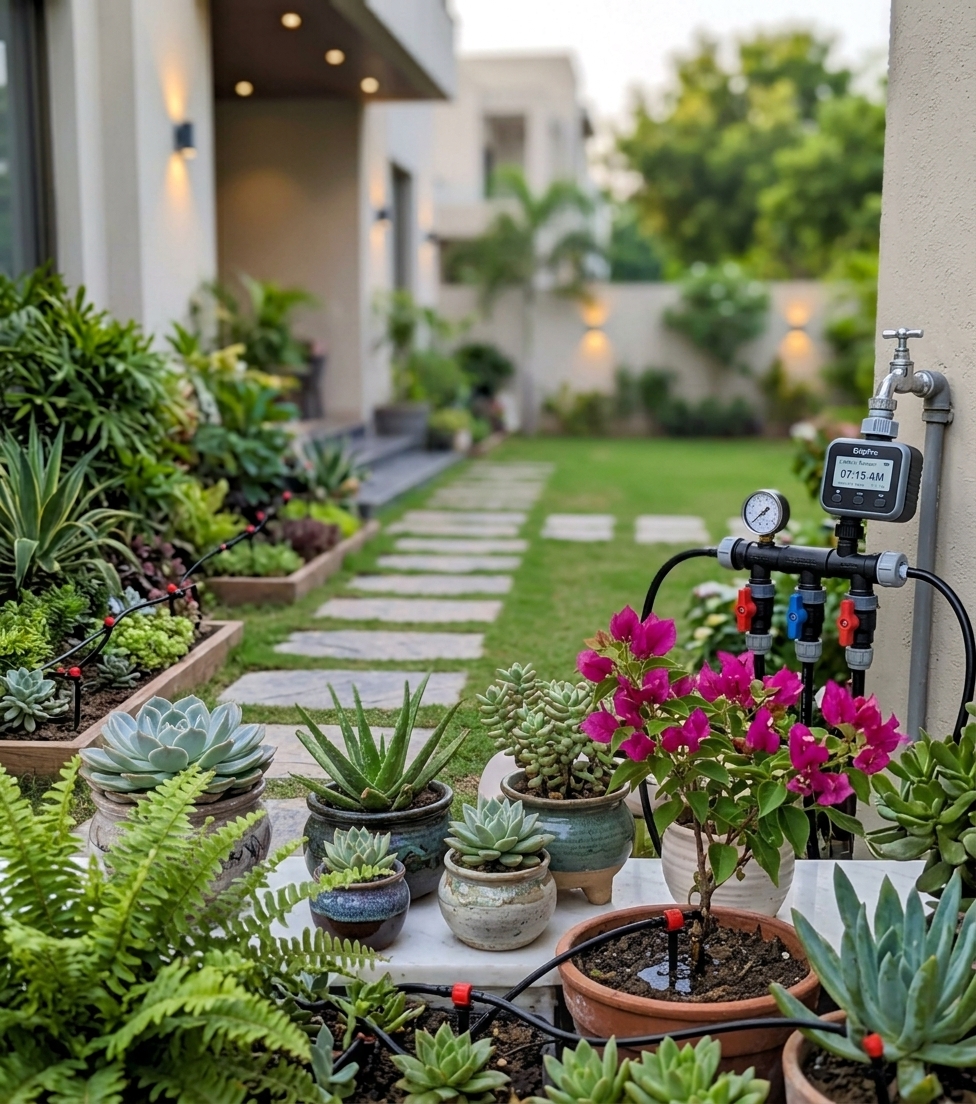
An automatic drip irrigation system is a low-pressure network that releases water drop by drop at each plant’s base. Small emitters, spaced along flexible tubing, control the flow precisely. Meanwhile, a programmable controller opens and closes solenoid valves according to a schedule you set. Therefore, the system can provide regular irrigation without requiring daily manual watering.
The concept is not new. In fact, drip irrigation was commercialised in arid regions decades ago and has since become widely used in water-scarce agriculture. Today, home gardens borrow the same basic engineering at a smaller scale. As a result, homeowners can control where, when and how much water is delivered.
How an Automatic Drip Irrigation System Actually Works
Water enters from your mains supply or a storage tank. First of all, a backflow preventer protects the potable line. Next, a pressure regulator reduces pressure to the level required by the irrigation components. After that, a filter removes sand and scale particles. Finally, filtered water moves into the distribution network.
Filtered water then travels through a mainline into zone valves. Each valve feeds one hydrozone, which is a group of plants with similar water requirements. Subsequently, lateral tubing carries the flow to individual emitters. Since every emitter has a defined discharge rate, irrigation demand can be calculated more consistently. For this reason, an automatic drip irrigation system offers much greater control than guesswork.
Where an Automatic Drip Irrigation System Fits Best
Drip lines suit shrub beds, palm rows, hedges, raised planters, rooftop gardens and potted collections. Moreover, they work well around pool decks, where overspray onto tiles may create staining or slippery surfaces. For example, our team can integrate irrigation lines during swimming pool construction so that necessary trenching can be coordinated during the wider project.
Large open lawns are an exception. In those areas, rotary sprinklers or subsurface dripline grids may be more appropriate. Nevertheless, many Abu Dhabi villas can combine different irrigation methods under a single controller. As a result, each landscape area can receive a watering method suited to its needs.
Why Abu Dhabi Gardens Need an Automatic Drip Irrigation System
Abu Dhabi has a hot, dry climate with limited natural rainfall. Consequently, landscape irrigation plays an important role in maintaining gardens throughout much of the year. In addition, efficient water delivery can help homeowners manage irrigation more precisely.
Climate Pressure and Evaporation Loss with an Automatic Drip Irrigation System
During the hottest months, midday sprinkler spray can lose water through evaporation before it reaches the soil. Furthermore, wind on exposed or coastal plots can increase spray drift. By contrast, an automatic drip irrigation system releases water at ground level, often beneath mulch. Therefore, less water is exposed directly to the surrounding air.
Sandy substrate adds another challenge because water can move quickly through the soil profile. For this reason, shorter and more frequent drip cycles may be suitable for some plantings. However, the correct schedule depends on plant type, soil, exposure and season. Automation makes these adjustments easier to manage.
Regulation, Sustainability and the Automatic Drip Irrigation System Advantage
UAE authorities promote efficient water use and water-resource management. Homeowners can therefore review national water strategy guidance through the official UAE Government portal. In addition, efficient irrigation can support responsible landscape management when systems are designed and scheduled correctly.
Arabic-speaking clients often ask about نظام الري بالتنقيط (drip irrigation system) and الري الآلي (automatic irrigation). Likewise, terms such as شبكة الري للحدائق (garden irrigation network) and توفير المياه (water conservation) appear in local landscaping discussions. Therefore, understanding this vocabulary can be useful when sourcing irrigation components or discussing requirements with local suppliers.
Core Components of an Automatic Drip Irrigation System
Quality hardware influences the reliability and service life of an irrigation network. For example, UV-stabilised components are better suited to intense sunlight. Similarly, properly selected filters and pressure regulators protect downstream irrigation components. Therefore, a professional specification should consider the complete system rather than individual parts.
| Component | Function | What to Specify |
|---|---|---|
| Smart Controller | Runs schedules and zone sequencing | Wi-Fi enabled, 6–12 stations, rain sensor port |
| Solenoid Valves | Open and close each hydrozone | 24 V AC, glass-filled nylon body, manual bleed |
| Disc or Screen Filter | Traps sand and scale | 120–155 mesh, flushable cartridge |
| Pressure Regulator | Protects emitters from pressure surges | Fixed outlet 1.0–1.5 bar |
| Pressure-Compensating Emitters | Deliver consistent flow along the line | 2, 4 or 8 litres per hour, anti-siphon |
| Flush Valves | Purge sediment from line ends | Automatic end-of-line type |
Pressure-compensating emitters deserve special attention. On sloped plots, gravity can otherwise affect water distribution between higher and lower plants. As a result, pressure-compensating emitters can help maintain more consistent output across the line. Hence, they are useful where elevation changes are part of the landscape design.
Automatic Drip Irrigation System vs Sprinkler and Manual Watering
Homeowners often compare three common irrigation methods. However, each method has a different application. The table below compares their typical characteristics and limitations.
| Method | Efficiency | Best For | Limitations |
|---|---|---|---|
| Drip Emitters | 90–95% | Shrubs, palms, hedges, planters | Emitters need periodic flushing |
| Pop-Up Sprinklers | 65–75% | Open turf areas | Wind drift and evaporation |
| Manual Hose | 40–55% | Very small balconies | Inconsistent, labour-heavy, easily forgotten |
Efficiency is only one consideration. In addition, homeowners should consider reliability, plant type, landscape layout and maintenance requirements. For example, a holiday trip or busy work schedule can make manual watering difficult. In such cases, an automatic irrigation system provides scheduled watering without daily manual operation.
Pipe Materials and Emitter Options for an Automatic Drip Irrigation System
| Material | Best For | Key Advantages |
|---|---|---|
| UV-Stabilised LDPE | Surface lateral lines | Flexible, easy to punch, resists sun cracking |
| HDPE (PN10/PN16) | Buried mainlines | High pressure rating, welded joints, long life |
| uPVC Schedule 40 | Valve manifolds | Rigid, solvent-welded, dimensionally stable |
| Inline Dripline (16 mm) | Hedges and ground cover | Pre-spaced emitters, root-intrusion resistant |
| Adjustable Bubblers | Palms and large trees | Higher flow, tunable output per tree |
Avoid unbranded black tubing sold without UV certification. Under Gulf conditions, intense sunlight can accelerate material degradation. Similarly, choose durable fittings near valve boxes, where repeated maintenance can place additional stress on connections. Therefore, component quality should remain part of the overall irrigation specification.
Designing an Automatic Drip Irrigation System for Home Gardens
Design should come before purchasing materials. Otherwise, you may over-buy tubing while under-buying valves or controller capacity. Therefore, follow a structured design process.
Step One: Map and Hydrozone the Plot
Sketch your garden to scale. Then, group plants according to their water requirements. Date palms, bougainvillea, ficus hedges and seasonal annuals can have different irrigation needs. As a result, each group should be considered as a separate hydrozone where appropriate.
Step Two: Measure Flow and Pressure
Fill a ten-litre bucket from your garden tap and time it. This gives you an approximate litres-per-minute flow rate. Afterwards, check static pressure with a suitable gauge. Zone demand should be designed within the available supply capacity. This calculation helps prevent uneven performance in an automatic drip irrigation system.
Step Three: Select Emitter Rates
Small shrubs may require one 4 LPH emitter, while medium shrubs may need more than one. Meanwhile, mature palms can require higher-flow bubblers depending on their size and soil conditions. Similarly, potted plants can use low-flow micro-drippers. Ultimately, emitter selection should follow the plant’s actual water requirements.
Step Four: Plan the Automatic Drip Irrigation System Controller Programme
Schedule irrigation during cooler periods, such as early morning, when practical. At the same time, avoid assuming that one fixed schedule works throughout the year. Instead, adjust run times according to season, plant maturity, soil conditions and weather. Smart controllers can also use available weather information to support scheduling decisions.
Expert Tip From Our Site Engineers
Always consider spare capacity at the manifold. After all, gardens can change over time. Two years later, you may want an extra zone for a new planter or a landscaping extension. Therefore, allowing future capacity during the original installation can simplify later modifications.
Automatic Drip Irrigation System Installation: Step-by-Step Process
- Isolate and tap the supply. First, fit a dedicated isolation valve and the required backflow protection at the connection point.
- Build the head assembly. Next, install the filter, pressure regulator and manifold inside a suitable valve box.
- Trench the mainline. Then, bury the mainline at the depth specified for the project. Additionally, sleeve crossings under driveways where required.
- Run laterals. After that, lay LDPE along bed edges and secure the tubing properly.
- Punch and fit emitters. Use a suitable punch tool so holes remain clean and fittings seal correctly.
- Flush thoroughly. Subsequently, open line ends and run water until the discharge becomes clear before capping them.
- Wire the controller. Next, connect the controller to the solenoid valves using suitable irrigation cable and waterproof connectors.
- Test every zone. Finally, run each valve and inspect the garden for dry areas, leaks and pressure problems.
- Mulch and commission. Once testing is complete, cover exposed tubing where appropriate and programme the seasonal schedule.
A skilled crew can complete a typical villa installation within a project-specific timeframe. However, complex plots with water features or an existing pool maintenance schedule may take longer. In such cases, careful coordination helps protect existing landscaping and pool infrastructure.
Automatic Drip Irrigation System Cost Guide for Abu Dhabi Villas
Pricing depends on garden size, zone count, controller intelligence, component quality and trenching difficulty. Therefore, the final quotation should be based on a site assessment rather than garden area alone. The ranges below are indicative planning figures and should be confirmed with a current project quotation.
| Garden Size | Typical Zones | Indicative Range (AED) |
|---|---|---|
| Courtyard / terrace up to 60 m² | 1–2 | 1,800 – 3,500 |
| Standard villa garden 150–300 m² | 3–5 | 5,500 – 12,000 |
| Large landscaped plot 500 m²+ | 6–10 | 14,000 – 30,000 |
| Smart upgrade to existing network | Reuse existing | 1,200 – 4,000 |
The long-term value of an irrigation upgrade depends on water use, maintenance, plant health and installation quality. For example, better-targeted watering can reduce unnecessary water application. In addition, consistent irrigation may help reduce plant stress when the system is correctly designed. However, actual savings vary from property to property.
Automatic Drip Irrigation System Maintenance and Seasonal Scheduling
Monthly Checks
First, rinse the filter cartridge as required. Then, walk each zone during a test cycle and watch for dry patches. In addition, inspect emitters for blockages or inconsistent flow.
Quarterly Tasks
Flush lateral ends regularly. Additionally, inspect valve boxes for insects, moisture and cable corrosion. As a result, small problems can be identified before they affect a larger section of the irrigation network.
Seasonal Programme Shifts
Irrigation requirements change throughout the year. For example, plants may need different run times during hotter months compared with cooler periods. Conversely, cooler weather can reduce water demand. Therefore, review the controller schedule regularly instead of relying on one programme throughout the year.
Scale Control in an Automatic Drip Irrigation System
Dissolved minerals can gradually affect small emitter openings. Therefore, regular filtration and line flushing are important. Where necessary, professional servicing can address mineral buildup using procedures suitable for the installed components. However, chemical flushing should only be performed according to manufacturer guidance and with appropriate safety precautions.
Seven Mistakes That Can Ruin an Automatic Drip Irrigation System
1. Skipping the Filter
Sand particles can block emitters. Therefore, proper filtration helps protect the network and maintain consistent flow.
2. Mixing Plant Types in One Zone
Different plants can have different water requirements. As a result, combining unrelated plant types may make scheduling less effective.
3. Ignoring Pressure Limits
Unregulated pressure can damage irrigation fittings and emitters. For this reason, pressure regulation should match the system design.
4. Watering at Midday
Peak-heat cycles can increase evaporation. Instead, schedule irrigation during cooler periods when practical.
5. Leaving Tubing Exposed
Continuous sun exposure can accelerate tubing degradation. Therefore, suitable covering or protected installation can help extend service life.
6. Never Flushing Lines
Sediment can collect at line ends. Consequently, periodic flushing helps keep downstream emitters clear.
7. No Rain or Moisture Sensor
Even occasional rainfall can affect irrigation demand. Therefore, suitable sensors can help pause unnecessary watering when conditions allow.
Why Homeowners Choose Atlanta Pools for Automatic Drip Irrigation Systems
Atlanta Pools Abu Dhabi provides outdoor water and landscaping solutions for properties in the UAE. In addition to pool-related services, our team works with landscape irrigation requirements where water distribution, pressure and zoning need to be coordinated.
Every project can begin with a site survey and assessment of the existing landscape. Afterwards, the irrigation layout, component requirements and quotation can be reviewed with the homeowner. Furthermore, proper commissioning helps ensure that each zone is tested and the controller programme is explained before handover.
We also support the wider outdoor environment. For example, you can explore our complete range of services, or read practical guides on the Atlanta Pools blog. Similarly, related services such as pool renovation and decorative water features can be coordinated with a landscaped outdoor area.
Ready to Install Your Automatic Drip Irrigation System?
Stop guessing and stop watering by hand. Instead, let our team assess your garden, review flow requirements, and develop an irrigation setup suited to your landscape. As a result, you can have a clearer plan for automated watering in Abu Dhabi.
Frequently Asked Questions
How long does an automatic drip irrigation system last?
With suitable UV-rated tubing, correct installation and regular servicing, an irrigation system can provide many years of service. However, individual emitters and fittings may require replacement sooner.
Can I run an automatic drip irrigation system from a water tank?
Yes. However, gravity alone may not provide the pressure required by some irrigation components. Therefore, a booster pump and regulator may be required depending on the tank and system design.
Is drip suitable for lawn grass?
Subsurface dripline can work for turf. Alternatively, pop-up sprinklers may be more practical for some large open lawns. Therefore, the lawn layout should be assessed before selecting the irrigation method.
Will an automatic drip irrigation system work during power cuts?
Controllers can retain programmed schedules in memory. However, valves and pumps still require power to operate. Therefore, irrigation will resume according to the system design once power is restored.
Can you retrofit an existing garden?
Absolutely. In many cases, irrigation can be installed around mature planting with careful planning. Afterwards, disturbed areas can be restored as part of the installation process.
Final Thoughts
Water is an important resource in any Gulf garden. Therefore, using it carefully can support both efficient landscape management and healthy planting. A correctly engineered automatic drip irrigation system delivers controlled water directly to plant root zones according to a programmed schedule.
Start with a proper survey. Then, review the garden layout, plant requirements, water pressure and available flow. In addition, insist on suitable components and accurate hydraulic calculations. With these factors in place, your irrigation system can be designed around the specific conditions of your Abu Dhabi property. Contact Atlanta Pools whenever you are ready to discuss your project.
Share this post: